Friday, 29 June 2007

Silent Hunter 4

Log 01. Usually I spend longer than three minutes with a game before starting a review, but Silent Hunter 4's awesome intro movie demands immediate wordage.

Some shining soul at Ubisoft has decided to prologue this World War II Pacific-theatre sub sim with a 17th century poem about mortality. John Milton's powerful 'On Time', beautifully spoken over an arresting collage of game clips, has just left me tearful and quivering with anticipation. Best start to a simulation ever! Now, let's see if the game can live up to such an opening.

Log 02. Two hours have passed since that last paragraph was written. I've romped through the 'submarine school' and a couple of quick missions, and my brain's message log now contains the following nine thoughts:
1. Oooooh! Lovely interiors. Very atmospheric.
2. The helmsman's waxy pallor and malevolent glare is starting to give me the willies.
3. Great, all the old SH3 controls still work.
4. Now that's what I call a battleship!
5. And it's got little sailors on the deck!
6. Dang, now how does this new-fangled US stadimeter work?
7. Flotsam, jetsam and lifeboats. Very nice.
8. Great, it looks like crew management is a lot simpler.
9. I wonder what sex with a dolphin would be like?

Expanding on numbers 3 & 6, the sub school is pretty shoddy really (text-based, unimaginative, no explanation of manual targeting or crew management) but it does teach enough to get newcomers up and silent-running. As in Silent Hunter 3, if you stick with automated torp targeting, activate aids like unlimited fuel and oxygen, and cheat occasionally by doing recon with the freecam, there's nothing whatsoever to be scared of. Well, nothing except for the depth charges, the mines, the six-inch shells, the razor-sharp keels, and the ragged rocks.

Log 03. OK, my first SH4 campaign patrol is over. For the last few weeks (in-game weeks) I've been stalking Japanese steamers in a balmy corner of the East China Sea. The surface of that sea is now approximately 0.00000000000015mm higher thanks to the 40,000 tons of iron I have sent to its bottom. Highlights of the trip? Using the deck gun to junk a junk off the coast of Okinawa would be one. Watching a torpedo clip the bow of a listing troop ship near Iwo Jima would be another.

Lowlights? Running into a juicy Jap taskforce on the way home to Pearl and realising I had nothing to throw at it except insults and sweaty underwear. Wish me luck for my second tour of duty.

Log 04. Well, patrol #2 went well (apart from that duel with the destroyer that prompted the reload of In_for_a_penny.sav). I got a good haul of vessels and feel my thoughts about the game are beginning to crystalise. As Ubisoft promised, out on ops you don't feel quite as isolated as you did in SH3. Communications from COMSUBPAC (US HQ) provide lots of useful info about convoy activity (the Japanese merchant fleet is surprisingly organised early on) and messages from Fox supply interesting news about the wider war. Sadly all these messages are accessed via a clipboard interface so fiddly I'd have hurled it overboard if it wasn't chained to the screen.

Although there are still no chess or battleships mini-games (inexcusable), there is now a recreational wireless and a gramophone to help while away long voyages. Rather than reach for the x8000 time acceleration you can loll on your bunk, listening to the Glenn Miller Orchestra, and ogling Betty Grable's shapely posterior.

That's the theory anyway. Actually there's very little period audio in the box (there are no mp3s for the gramophone at all and few of the 20-odd Radio Washington reports are longer than a minute). You'll have to wait for the community to rustle up some sounds before you can fill your sub with swing.

The other thing standing between you and that cosy bunk fantasy - apart from the absence of Crimson Skies-style selectable pin-ups - is the lack of bunks. Silent Hunter 4's subs actually come with fewer modelled compartments than their SH3 counterparts. Losing the virtual radio shacks and captains' quarters is not disastrous - especially as the new command rooms are decorated so diligently - but you do have to wonder whether the designers' 'more is more' approach was the right one. Hands up who would have preferred to have just the Gato class (the workhorse of the Pacific War) recreated down to the last greasy galley, cramped cot and stinky head rather than a selection of seven types modelled in much less detail? Ah, I see. Just me then.

Log 05. Something weird just happened. After my last patrol I did all the usual stuff - stocked up on eels, spent renown points on new crew and boat upgrades, and dished out medals and promotions - then I chose to transfer to a new home port. Java was the only one on offer and looked to be nice and close to the enemy. It turned out it was nice and close to the enemy. When the loading screen lifted I found myself moored slap-bang in the middle of a bustling Jap harbour. Within seconds I was captaining a smoking sieve. It looks like the campaign is going to need a few tweaks.

Log 06. Another sweaty-yet-rewarding hunting trip. This time I bagged a pair of destroyers and a cocky seaplane as well as the usual haul of freighters, sampans and saki tankers. Interestingly, I also got to try out one of the new mission types (see 'I Sink Therefore I Am'). These activities help to keep the 'This is just Silent Hunter 3 with warmer weather' thoughts at bay, but even so there have been times over the last few days when I've had to remind myself I'm not back in the North Atlantic in U-233.

The numerous graphical improvements, and added and overhauled features, don't alter the fact that hunting freighters and dodging escorts in Silent Hunter 4 is just like hunting freighters and dodging escorts in Silent Hunter 3. The tactics I use, the tactics they use, are all virtually identical. Maybe I'll find the freshness I'm seeking in the game's new adversarial multiplayer mode.

Log 07. Crikey, yes, that's where it's hiding! I've just mauled, or more accurately, attempted to maul a convoy controlled by a live opponent. Brow-beading, nail-nibbling fun! He was giving orders RTS-fashion from a 3D bridge while I prowled around, occasionally pushing my periscope above the foam to target a plump merchant. It's not quite the Destroyer-Command-2-with-full-interoperability-dream, but it's a wonderful stopgap.

Log 08. Multiplay is the only chance you're going to get to hunt as part of a wolfpack in Silent Hunter 4. Ubisoft still haven't got round to adding AI subs. Perhaps if they had, and I'd had to acquire new skills to hunt and elude them, then I'd be passionate rather than just enthusiastic about this excellent sim.


Diambil dari http://www.computerandvideogames.com/article.php?id=161863

Thursday, 28 June 2007

Spider-Man 3

You realised this was a piece of merchandising, right? In case you didn't realise it, it says so twice on the first splash screen. 'Official Spider-Man Merchandise', it says, right next to the less official-looking 'Spider-Man Merchandise' badge.

They might as well put a little BBFC grid on the back that says, 'Contains commercial cynicism. Suitable for clueless parents, naive fans and dribbling three-year-olds screaming 'Maa! Maa! Spoo-da-mang!' in the supermarket'.

There, that's my token dig at film tie-ins out of the way. Now I can admit that I've pretty much enjoyed a couple of the Spider-Man games so far, and this fits snugly into that Spideygame mould. Swing around the city solving crimes as you find them. Have your disbelief-suspension molested by 'mission activation' tokens, which progress the various storylines with cut-scenes. Unlock more and more moves, and annoy more and more gangs. At worst, it's an average string of scraps made bearable by the fact that you're swinging around like a good 'un. And to give Spider-Man 3 its due, the web-slinging feels good.

The missions are divided into fights, chases, defusing bombs, photography and swinging around with Mary Jane. It's not really worth describing all the mission types separately, because they all involve the same thing. You follow waypoints (so many waypoints) and then either have a fight or defuse a bomb. Defusing a bomb is a strange metaphorical process - it's a combination of Dancing Stage-style button-bashing, Paradroid and 'rotating the thumb stick'. Sound fun? It is, a bit.

For a while. Not quite so much after the umpteenth bomb tour.


BAD MOVES
Fighting is a process of building on your four basics - fast, strong, dodge and web - and your ever-growing bank of unlocked special moves. On mouse and keyboard, it's the predictable, unmanageable, third-person whirligig that'll have you puking out a forgotten sandwich, and this is also true of navigating the city. Once you set up your gamepad - and even that proved to be a shockingly difficult feat here - you'll only be lurching forwards occasionally to enter camera mode.

When you consider that the game is far too ugly to be shown on an unforgiving monitor - cel-shaded Ultimate Spider-Man looked infinitely better - and that it asks for an unjustifiable 6GB of HD space, and that we couldn't get more than 30 frames-a-second out of a fairly hot PC... Well, it doesn't seem like the best way to spend £30. Our advice would be to avoid the PC version of Spider-Man 3 like a spunk-filled bowler hat.

Diambil dari http://www.computerandvideogames.com/article.php?id=164530

Wednesday, 27 June 2007

Resident Evil 4 for PC

The Good

  • Exciting action sequences pit you against awesome enemies and fearsome bosses
  • character models and environments look sharp and realistic
  • superb sound design keeps you on the edge of your seat.

The Bad

  • Controller required, thanks to complete lack of mouse support and mediocre keyboard controls
  • blurry cutscenes and other visual issues detract from the spooky ambiance.

In 2005, Resident Evil 4 on the Nintendo GameCube was rightfully lauded as one of the best action adventure games ever released, thanks to stunning visuals and white-knuckle action sequences that ranked amongst the best in gaming. Later that year, PlayStation 2 owners were blessed with their own version of the game, featuring more missions and some other unlockable goodies. And now you can play Resident Evil 4 on your PC for a mere $20. It's too bad that PC gamers have been inflicted with a lazy port that does as little as possible to cater to the platform. Forget mouse support, forget tailoring the visuals to your own preferences, and don't even think about any PC-only goodies: this is a direct transfer of the PlayStation 2 version. If you can get past all these problems, RE4 is still an intense, thrilling ride that will keep your heart pounding. But if you still haven't played Resident Evil 4, this version should be your last resort.

In case you haven't gotten wind of what the game is all about, you play as Leon S. Kennedy, a secret agent in charge of recovering the president's kidnapped daughter. His search leads to a creepy Spanish village where the residents are, well, not quite lucid. The story drops the occasional cliché, but for the most part, it avoids the usual horror pratfalls to deliver an interesting and intense narrative with a number of fascinating characters. It's also genuinely creepy, leading you through abandoned farmhouses, dank churches, and dripping caves, all the while throwing progressively weirder and stronger enemies at you. Like the PS2 version, it also includes a side story called Separate Ways, where you take control of spy Ada Wong and explore some of the same storyline from her perspective.

The success of a survival horror game has a lot to do with its atmosphere, and this version of Resident Evil 4 features plenty of it. But that isn't to say that it looks superior to the GameCube and PS2 versions. Character models and environments are beautifully designed. They were also obviously created with deliberate care and detail. Of particular note are the boss characters, which get more vulgar and imposing as you progress. But a lot of ambiance has been lost in the translation. Because the grainy fog is gone, everything looks clearer but less sinister than before. It also means that you notice a lot of low-resolution textures that greatly contrast with the more remarkable aspects of the visuals. However, the cutscenes are the biggest graphical drawback. While the GameCube version of the game rendered the cinematics in real time, this one borrows the prerendered scenes from the PS2. They are blurry and badly compressed on the PC, as well as a little unsightly. Additionally, you cannot tailor any visual settings, aside from the display resolution.

Thankfully, the audio doesn't suffer much, if at all. Resident Evil 4 is a sonic spookfest, from the creepy minimalist soundtrack to the outstanding weapon effects. In fact, the most memorable aspects of the game are accompanied by equally thrilling audio, such as the roar of the gigantic bosses or the disturbing murmurs of villagers as they infiltrate your personal space. For what it's worth, Pro-Logic II technology is supported while true Dolby 5.1 is not, yet it's not likely to impact your experience much, particularly if you use a decent set of speakers.

The biggest oversight amongst all these porting issues is that of controls. Resident Evil 4 doesn't support mouse controls, though it does offer a mildly clumsy keyboard-only scheme. Plenty of console-centric games play better with a gamepad, but there wasn't even an attempt to implement decent PC controls here. To experience the game the way it's meant to be played, you need to plug in a gamepad. Whichever method you choose, the controls present an issue during the famous context-sensitive moments that require a few split-second button presses. If you end up using the keyboard controls, make sure to memorize which key is button 1, which key is button 2, and so on. The same issue exists with a controller, though it's a bit easier to get the button presses right because the in-game diagrams are tailored toward gamepad users.

Once you get past all these issues and plug in your controller, you'll find this is the same Resident Evil 4 that multitudes of players have grown to appreciate. It's a carefully paced, often breathtaking action game that keeps you on the edge of your seat with lumbering almost-zombies, chanting cultists, and challenging fights against gargantuan bosses. You view the action from a third-person view, and when you ready a weapon, the camera zooms in close. Once you've drawn your weapon, you can't move, but you can aim. It all feels very deliberate, but it's perfectly countered by the measured speed at which your enemies approach you. However, you shouldn't take this to mean that the action is any less exciting than in a traditional shooter. These are dangerous foes, and you've got to pump them full of lead before they fall.

The fundamental combat is where the game shines most. Your arsenal consists of pistols, shotguns, rifles and more, with every weapon producing credible results. Popping pitchfork-wielding villagers will cause them to drop their weapons. Or you can shoot them in the knees to make them momentarily fall to the ground. Because ammunition is not terribly plentiful, being able to handle a crowd of shambling psychopaths with as few shots as possible is a main priority. You've always got a knife as a last resort, but unless you want to take a chunk of damage, it's better to keep your distance.

Contextual actions also contribute to the general sense of urgency. Don't expect to sit back and snooze during the cutscenes because many of them require interaction in the form of a couple of button presses. If you're sleeping at the wheel, Leon will be crushed by a boulder or strangled by a hulking foe, and you'll be treated to a game-over screen. Other context-sensitive actions allow you to jump from a window, catch a companion from above, use a grappling hook, and more, depending on the onscreen action.

There's a lot of gameplay to be had here, with close to 30 hours of high-quality action and a few good reasons to head back once you're done. It's a shame that the PC got shafted with such a lazy port. It's also hard not to wonder why Capcom and Ubisoft even bothered with it. The PS2 version is unchanged in the sloppy transition to PC, so if you have no other way of experiencing Resident Evil 4 and own a gamepad, the core gameplay and budget price are enough reason to pick it up. Otherwise, pick up a different version and hope that the developers show a little more respect for the platform next time around.

Diambil dari http://www.gamespot.com/pc/adventure/residentevil4/review.html?om_act=convert&om_clk=gssummary&tag=summary;review


Monday, 25 June 2007

Age of Empires III

Few franchises have as much to live up to as the Age of Empires series, which has consistently amazed PC gamers with elegant gameplay and graphics so good that playing it frequently draws crowds of backseat gamers ("Oh! Oh! Now build a chariot!"). To date, the Age franchise has sold over 16 million units, incredible for a PC game. Neither Microsoft nor developer Ensemble Studios want to mess with the magic: to that end, no expense has been spared in making Age of Empires III the most visually stunning, intellectually engrossing real-time strategy game available.

Last month we had a chance to take a spin through AoE III at Microsoft's headquarters in Redmond, Washington, and this week we're finally allowed to spill the beans on what we saw. The game's progressed a good deal since this preview, but it was a luscious first glimpse of the engine in action.

Empires Come to Life

Picture, if you will, a crisp autumn morning off of the shores of the Great Lakes. In future centuries, this fertile stretch of ground may someday be a Chicago or Milwaukee, but right now it's home to scattered patches of settlers, and winding, rutted wagon trails. In Age of Empires III, this whole tableau is brought to life with a million little details. For instance, white smoke drifts lazily up from the chimneys of the log cabins, and a small English flag waves from a pole in the center of town. After a few moments it becomes clear that the flags and smoke are not static animations, but shift regularly and change direction with the invisible wind.


As we scroll the screen toward the lakes and away from the settlement, we start to see more animal life milling around the swaying woods. In one corner, a bear shakes a tree in order to down a squirrel who clutches for dear life. It turns out that the bear (and the critter he's chasing) are just a couple of the nearly 50 types of animals that players will find on either North American continent. Further up the woods we see a herd of deer ambling peacefully along. Here, we pause to admire the game's dynamic lighting: as a doe walks under the swaying branches of a tree, we can see the dappled sunlight on her back. Elsewhere, individual leaves fall from the handful of trees that have started to change their colors.

Waiting on the lake itself is a small fleet of boats, bobbing with waves and reflected in the relatively placid lake water. The boats are gigantic, and rendered with loving detail. You can see each and every line of rigging, and the sails ripple in the wind. The ships are so beautiful that it's almost a shame to get them into combat. Not that that's going to stop us. While we didn't spend a lot of time watching ship-to-ship combat, some very cool effects were present. Plumes of white smoke erupted from the cannons and drifted across the water, and individual cannonballs could travel through the sails of enemy ships.

Across the lake, a small Native American village prospers. It seemed like there were dozens of little animations playing in this tiny community. Women prepared hides, people paced between tents, and near one building a little kid walked along the top of the fence, carefully balancing as he strode along. "Alive" is really the only way to describe the graphics.

Of course, this was just one environment: later during our whirlwind tour of the game we got to see the frozen ice flows and treacherous water of the Northern part of the continent, where soldiers left footprints as they trudged through the snow. Marshy swamps, dense forests, and rocky highlands are also available in the game. Dozens of environments will be featured from all over North and South America.

(For more details about the graphics and the technology behind them, check out this extended feature on the AoE III engine from GameSpy's GDC Coverage.)


Strategy is Still the Key

Ensemble's design team sees this game as their opportunity to refresh the real-time strategy genre with some tweaks and additions to classic play. The team wants to focus on strategy: players will win not just based on how fast they click on their units, but how they maneuver and use them.

One way that strategy is emphasized over reflexes comes about by using a new concept called the home city. In AoE III, players represent various European powers colonizing the new world. The game action itself will take place in the Americas, but the player's power base is represented by his "home city" in Europe. In-game the home city appears as a beautifully rendered European capital -- it looks almost photographic. Resources from the New World can be used to upgrade your home city, which in turn can support you by developing new technology or by sending special new units as reinforcements.

There's a great deal of strategy in determining how you'll advance your capital. A defensive player might select upgrades that will allow him to build towers, for example. An aggressive player might constantly request boats loaded with high-powered reinforcements. Your home city "levels up" almost like an RPG character, meaning every player will have different strategies and even single-player campaigns can take on different flavors. You can even personalize the home city with touches of your own as you play.

Meanwhile, over in the New World, the natives will play a huge role in the player's strategy. Native citizens can support your colonial goals with troops or technology, but only if you have a good relationship with them. In practice, this means that a multiplayer game plays out as a race to establish strong ties with the locals. You can swing them in your favor by destroying enemy trading posts while building your own. Your opponent will be doing the same! Various home city upgrades can help you win over the natives faster.

Combat itself is very dependent on formations, as it often was during this time period. Managing your formations is a huge part of the game. If you set a large group of musketeers into a "volley" formation, they'll line up, take a shot, then step back so that another row can shoot. This is as opposed to a "Charge" formation, where they'll fix bayonets and rush forward. A good army will have a good mix of different units. The musketeers described above are vulnerable to skirmishers (as the Brits found out during the Revolutionary War), but they're good for defending against cavalry. Calvary, meanwhile, can mow down skirmishers.

And, of course, you also have artillery, which is very important in Age of Empires III. You can bring huge field pieces into battle, which are devastating against large groups of infantry, but susceptible to a cavalry charge. It's also interesting to note that artillery is now needed whenever you wish to destroy enemy settlements. That's right: no longer will a guy with a spear bring down a town center by poking it for 10 minutes. You'll need to bring in (and protect!) the big guns.


If it sounds like a lot to keep track of, don't worry. AoE III also makes efforts to do away with a lot of the micromanagement common to other real-time games. For instance, unlike AOE II, farms will automatically replenish themselves, and raw materials don't need to be carried back to buildings -- they're simply mined or harvested on the spot. Little changes like this mean that players will be focused on acquiring strategic parts of the map, advancing their home city, developing relationships with the natives, and managing the movements of their troops.

When it All Comes Together

During this tour of the game we only got the briefest introduction to the gameplay itself. But it looks as though when the empire-building and combat elements come together, it'll be spectacular. Age of Empires III uses real-time physics, leading to some amazing imagery as cannonballs skip along the ground through lines of troops or crash into buildings. The little soldiers can really go flying; hats and muskets will whirl in the air. It's even possible to knock guys off of cliffs. And individual buildings are never destroyed in the same way twice: cannonballs will tear off chunks of the architecture, which will spin through the air and crash into other buildings, exposing flaming timbers below. It's possible for cannonballs to smash their way all the way through a building, thudding into the ground somewhere on the other side.

Eye candy is great, but if the game truly is as strategically deep as the designers hope, it may be the most influential Age title yet. We hope to get some actual hands-on time with the game in the weeks to come, so stick around GameSpy for details.

Diambil dari http://pc.gamespy.com/pc/age-of-empires-iii/605149p1.html

Monday, 18 June 2007

The Lord of the Rings Online: Shadows of Angmar

Evil looms once again in the lands of Middle-earth. Creatures and monsters of Mordor are amassing as the hunt for The One Ring rages on, and all of Middle-earth is threatened by this evil power. In order to stop this evil and bring back peace, all races — Humans, Hobbits, Dwarves, and Elves — must come together and stop this tyranny. Will that be enough? It is up to you, adventurer, to work alone or with others and stop Mordor's forces! The battle doesn't only take place in Mordor, for all the lands of Middle-earth are engulfed in evil as Sauron's forces search for the ring, including Ered Luin, Rivendell, and the Shire. Now grab your sword, bow, or even your staff, and save Middle-earth!

The hottest game genre on the market these days seems to be Massively Multiplayer Online Role-Playing Games, and titles like The Lord of the Rings Online: Shadows of Angmar are the reason why. The amazing world of Middle-earth created by J.R.R. Tolkien, and the tales set within it, are unknown to few people. Many tales have started as books, transitioned into movies, and are then made into games, but out of those many stories, only few are successful. LotRO is one of those successes.

Upon entering LotRO, you are confronted with the basic storyline and crisis. LotRO takes place before Frodo and his joyous adventures, so the "fellowship" doesn't exist yet. Sauron has split his forces, sending Nazguls to look for the ring, and the rest of his forces have orders to attack the civilizations of the world.

After the introduction, you are prompted to create your character by selecting from four races: Humans, Elves, Dwarves, and Hobbits. Each of those have the option of being male or female, except for Dwarves (but who wants to be a short, hairy female dwarf anyway?).

Along with your race, you can choose from seven different classes: Burglar, the rogue-like class that specializes in stealth; Captain, which uses its leadership abilities to command and aid their allies in battle; Champion, which is heavily focused on combat skills; Guardian, which can take massive amounts of damage; Hunter, which lays traps for enemies and uses bows to deal ranged damage; Lore Master, which uses magic and pets in battle; and Minstrel, which uses instruments and songs to heal and buff their allies, as well as deal light damage to foes. I chose the path of an Elven Minstrel and was given a few options as far as avatar customization goes, but there weren't many possibilities. With my voice attuned to several ballads, I entered my homeland of Ered Luin.

However, all was not well in Ered Luin! Sauron's forces had already begun to attack the city walls, which smoothly segues into your tutorial mission, in which you are confronted by half a dozen goblins. After you've dealt with them, you are shown a cinematic regarding the destruction of the city, and you enter the actual game world, where you can interact and converse with other LotRO players.

Much like any good MMORPG out there, there is no set path for you to follow. You can collect quests around the starting area and complete them while killing a few creatures here and there for the additional experience, or you can find other methods of having fun while completing the quests and leveling up. I personally found that the fastest way to level up was by questing, and grinding yielded very little experience. This is a lot different from most MMORPGs, where there tends to be a lack of quests but plenty of monsters for you to grind on.

This brings me to the PvE, or Player versus Environment, aspect of LotRO. Out of all the MMORPGs I've played, LotRO simply has the best PvE. Not only is it amazingly fun to explore famous sites from Tolkien's lore or doing interactive and exciting quests rather than the typical tasks of "kill X, kill Y," but the sheer number of quests is also amazing. Additionally, the fact that quests level up your character faster than typical grinding makes me feel as if I am affecting the entire game world rather than embarking on my own personal quest to hit the level cap, which is 50 at the time of this writing.

One of the most unique and exciting elements that LotRO brings to the ever-growing MMORPG community is the system of deeds. Deeds are generally split between Racial Deeds, Class Deeds, and Area Deeds. Picture a deed as a goal that is hard-coded into the game and done at your leisure. Need a little bit of experience, but do not feel like doing a quest? Head behind the local inn and slay a few wolves for that Ered Luin Wolf Slayer deed. When you kill about 30, you unlock a reward: a title to display after your name, such as "Geraldo, Guardian of Ered Luin." However, the real benefits are for completing advanced deeds, like slaying 50 or 100 of these wolves. Rewards include an increase to certain stats, a new skill or two, or maybe even a rare title to awe your friends.

From Bree to Angmar to The Shire, Middle-earth in its online game form is simply beautiful. Turbine shaped Middle-earth to look as epic as it did in the movies, and honestly, that alone makes the gameplay very exciting. Pointing out that, "Hey, Frodo lived here," or "Gandalf has been here," makes the experience that much more memorable, and each time you trek to the top of the hill or travel through a forest, you reach the other side wanting to see how gorgeous the next awaiting hill will be. From the highest to the lowest graphical setting, LotRO looks great for an MMO, and without a doubt contains some of the best graphics that I have seen.

The music in LotRO is no different from the movie soundtracks: epic. From the background harmonies to the grunts of me swinging my sword or the tunes of me singing ballads and performing music, everything sounds impressive. Ambience, immersion and combat bring a realistic feel to the gameplay experience.

We know that the graphics and audio of LotRO are out of this world, but what about the actual gameplay? Perhaps the most important feature of a fantasy MMO is its combat system. LotRO uses the well-developed system of targeting and using the number keys to use different skills and abilities. The cool thing is, if you don't have enough room from the "1" key through to the "=" key, you can establish numerous subsets of the numbers with the Ctrl, Shift, and Alt keys, for a total of 48 possible key combinations. As for the actual enemies and monsters you will be fighting, goblins, orcs, deadly spiders and even ogres have been seen in LotRO, and they are eager to beat the snot out of anyone they see who threatens the rule of Sauron.

LotRO certainly isn't the first MMO to have a crafting system, but again, LotRO's is the best by far. Basically, the game has 10 different professions: three gathering (Farming, Foresting, and Prospecting) and seven production (Cooking, Jewel-crafting, Metalsmithing, Scholaring, Tailoring, Weaponsmithing, and Woodworking). Iin essence, you can have three professions — but not any three. The game allows you to choose a single vocation, each allowing three of the possible professions. For example, the "Armsman" vocation can take up the Prospecting, Weaponsmithing, and Woodworking professions, while the "Historian" vocation can take up Farming, Scholaring, and Weaponsmithing.

Perhaps one of the most important features of MMORPGs these days is the Player versus Player, or PVP. Games like World of Warcraft brought such an advanced and enjoyable style of PvP to the genre that it is almost impossible to recreate without making it seem too forced. LotRO's form of Player versus Player is called "Monster Play." At all of the main cities around the world, you can use a Fel Scrying Pool, which enables you to choose from a handful of different monsters — spiders, goblins, and more — all starting at level 50, and enter the area called The Ettenmoors. This is a level 50 area, so your monsters will be on equalt footing with any level 50 players.

You use your monster to fight NPCs and other players' main characters, all while collecting "Destiny Points." These Destiny Points can later be applied to your actual character to create brief time-based perks and bonuses, including an increase to experience gain, speed, and other cool little features. The PvP seems fun, but unfortunately, since LotRO just came out, there weren't many (or even any) level 50 players when I played this. Because of this, I cannot truly discuss the enjoyment of PvP or any balance issues I saw. It does seem to be very fun and different, though.

Another sought-after element of MMORPGs is the end-game Player versus Environment, or end-game raiding. As of now, raiding is non-existent, like it is with most new MMORPGs, but June 13th is just around the corner and marks the first content updated for LotRO. Entitled "Book 9: Shores of Evendim," the content update will feature the entire new area of Evendim, including over 100 new quests and the first raid dungeon: Battle for Helegrod, a raid demanding 24 players in order to succeed. It sounds very entertaining, and will no doubt rank up in the enjoyment of raiding in comparison to other MMORPGs. The content update will also include new armor sets and tweaks and updates to the music system.

Speaking of the music system, that is another fun and interactive element to LotRO. The game features tons of instruments from flutes to bass, allowing you to sit around the tavern all day and amuse nearby visitors; maybe even earn some gold! In the upcoming patch, players will have the ability to compose music offline, upload it to their characters online and play the music they composed! LotRO truly is for both role-players and hardcore gamers alike, and the two balance equally, giving great quality and interaction while at the same time leaving options in the players' hands.

With a great launch and exciting features planned for the near and distant futures, Lord of the Rings Online: Shadows of Angmar is certainly the MMORPG of the year so far. Turbine has come out on top once again and proved that if "Lord of the Rings" could be turned into a successful MMORPG, they would be the ones to do it. That they did. Probably the biggest question about LotRO is, "Does LotRO have the potential to surpass World of Warcraft?" The answer is yes. Not only does LotRO take place in the world that created the fantasy theme, but the title is far more polished and ahead of any MMORPG during its release. Only a short time afterwards, Turbine is already releasing a large content update to prove that they are taking things seriously. LotRO is worth a try for anyone who is fans of Lord of the Rings or MMORPGs in general, and it would be your loss to not give it a whirl. In my opinion, Lord of the Rings Online: Shadows of Angmar is certainly, one of the best games to hit the shelves this year.

Di ambil dari http://www.gamerankings.com/itemrankings/launchreview.asp?reviewid=783417

Friday, 15 June 2007

Shadowrun (PC, 360)

Sometimes, a certain game comes along that's just a complete pain to review. Whether it's a title you really wanted to like but let you down immensely, or a game that plays well but has one or two huge flaws, I sometimes find myself at a loss about certain games.

Shadowrun is one such game. To most, the magic-based shooter is an abomination to the license and, as such, it should be cast back to whence it came. To be fair to those with said opinion, the Shadowrun license is not used to its fullest. The game uses very little of the backstory—with only a few small sequences for the intro to each tutorial chapter, and some remedial text in the game's instruction manual and official web site—and there are quite a few flat-out omissions and liberties taken with the core content.

It's futile to attempt to argue that Shadowrun is a worthwhile use of the base license. The verdict has already been decided. What I can instead do is give you an idea of how the game plays and hope that prejudices can be put aside for the sake of a decent game suffering the misfortune of ill planning.

ShadowrunShadowrun is a competent online shooter that implements a few neat ideas, most of which enable the game to be a very enjoyable and unique experience online. I say "online shooter" because, as most of you know, the game includes no single-player campaign and no local multiplayer, a discouraging blow considering the game's cost. There's an offline bot match and the training, but that's it.

The online gameplay revolves around three different game modes: Raid, Extraction, and Attrition. Attrition is the typical deathmatch, while Raid and Extraction are Capture-the-Flag variants that focus on a flag-like object called "The Artifact." And that's pretty much it. Not a whole lot of content for your money, especially when you factor in the limited number of layered-but-small maps, extremely limited weapon selection and stylistic-though-unimpressive graphics.

But the game's value is derived from the complex orchestration of the game's action. After choosing a race—each of which has a variety of different strengths and weaknesses (a far cry from the skin-only differences of most multiplayer shooter avatar selections)—each player has the ability to pick out a selection of weapons, magic spells, and tech items. While each branch may only contain seven or eight different choices, the resulting combinations leads to a high level of variance amongst players, and an ever-changing gameplay experience.

During the course of the game's play, players are able to employ the system's various offerings in a wide variety of ways. Defending with summoned creatures, sniping from high above while gliding from rooftop to rooftop, teleporting through walls to quickly snag the Artifact: when it works well, the game plays great. Shadowrun, at its core, is a fun game.

Shadowrun2 There are some nagging issues above and beyond the content inclusions, though, that may further sour the deal. Coping with the game's aiming system—especially for those on the PC—takes a while to get used to. This isn't a pixel-perfect shooter akin to the standard PC fare. Likewise, connection variances will likely lead to more-than-occasional performance maladies, which will render certain rooms all but unplayable.

Other issues, such as the game's contorted interface and its lack of a true room list, leaderboards, and stat tracking, leave the game feeling incredibly shallow for a $60 product. And really, all the great gameplay in the world doesn't change the fact that the package may not be worth $60.

The core game is really a lot of fun to play, and for two platforms saturated with shooters, Shadowrun is a refreshing take on the tired multiplayer formula. Whether or not the game is worth the admission price will depend wholly on whether or not you have the friends list to enjoy the game with. Either way, though, at least rent the game and give it a shot, or try the demo that's due to hit the Marketplace soon: it's worth at least a test run despite all the bad things said about the game by those who haven't even played it. You may not be driven to buy it, but at least you'll have the opportunity to realize that even a loathed game can be something worth playing.

Ben's Thoughts

Every time I play this game, I end up having a good time, but then after I'm done I'm back to realizing why people hate it so much. When the developers decided to make a game with the Shadowrun license, they knew they'd be looked at by the Shadowrun fans, and going against everything that community wants in a game was a bad mistake. Making the game Vista only was a bad mistake. Being so concerned with play between console and PC gamers and adding auto-aim was a bad mistake. These are glaring flaws.

Then when you get into a game with dedicated players and start teleporting through walls to slice someone up with a katana you realize that with just a few tweaks, the community could have been behind this game. The actual mechanics and interplay of magic and tech work well, and there are many combinations of weapons and spells and upgrades to play around with. Everyone has their own favorite loadout, and the different races do make a large difference in how you engage your enemy. What the game does wrong conceptually is partially redeemed by what the game does right in actual play.

Still, you have to think calling it Shadowrun and using it to push Vista were two very easy ways to incense the PC gaming audience. I just hope people who aren't as protective of the license at least give it a rent; there is much to like about this game.

Verdict: Rent
System: PC, Xbox 360
Price: $50 on PC, $60 on Xbox 360
Rating: Mature
Developer: FASA Studio, Microsoft Game Studios
Publisher: Microsoft

Diambil dari http://arstechnica.com/journals/thumbs.ars/2007/06/06/game-review-shadowrun-pc-360

Nintendo's Pipelines: An Interview with Nintendo Software Engineer Takeshi Shimada [ 2 ]

GS: A lot of companies were very secretive about their engines, graphical advances and things like that, to the extent that when Hudson was trying to remake their Tengai Makyo series on GameCube, they had to start with the sequel because they lost the source code to the first game, since they had ensconced it away so cleverly that even they couldn't find it.

TS: (laughs) I don't know too much about how Hudson works, but that's pretty amusing. If you look at things purely in terms of how development is working to get teams ahead, I feel like the U.S. is sort of a frontrunner in terms of providing tools and matching workflow with various teams.

GS: How has Nintendo restructured itself to maximize production, in terms of workflow and how assets are passed around?

TS: There's constantly a process of trying different things in that area. It's hard to nail down a single process. It's rather experimental. I find that just the pure penetration of information is something that's very important to consider. One of the most important things in my job is making sure that accurate information gets out to all departments as quickly as possible, so that everyone is on the same page. It's not really a matter of the human communication we were talking about earlier, but also the penetration of information, so that not only are people talking, but they're talking about the same thing. One of my jobs is to make sure that this information sinks in broadly and deeply.

GS: Does Nintendo use only its own internally-developed tools?

TS: Internally-developed tools are used at Nintendo if they're better than anything else that can be found outside the company. Whenever we feel the need for a particular tool that we haven't already developed or don't have the resources to commit to in any given moment, we start to test outside tools and as soon as we find one that fits our needs, we'll begin collaboration with an outside maker.

GS: So Nintendo does currently use some outside tools?

TS: Yes, that's right.

GS: Have you found it difficult at all to provide new libraries for the Wii, since it has a new kind of input?

TS: It's not so much that they're really hard to provide, it's that there's so many needed. There's a lot for us to do.

GS: Microsoft is providing development libraries for anyone with their Game Studio Express. Is this something that Nintendo might be interested in pursuing?

TS: I haven't heard anything about plans to do something like that.

GS: How different is the graphics chip in the Wii from the GameCube's chip, and why create a new one specifically for the Wii?

TS: Very generally speaking, people tend to expect somewhat of a linear progression in terms of the graphical and sound capability of machines like this, but the Wii really represents a departure in that way of thinking in this evolutionary line. One of the things that we have tended to consider in the development of this hardware is that we might consider producing games with lower processing needs, and so as we were thinking about that, that actually went into our hardware development. It wasn't so much that there was like a stall in progress between GameCube and Wii, but rather Wii is a totally different kind of system. We were just thinking of what the needs would be eventually in our development cycle. So, we approached it as a completely new platform with a very different scale.

When thinking about our graphics and audio pipeline on Wii, we needed totally new development tools. This time around, there are so many new features -- things like wireless, the way the remote works -- that it basically meant starting over with new dev tools as well.

GS: What has been your biggest challenge in terms of software and tools development for Wii?

TS: Whether we're talking about the Wii or the DS, what I take as my personal challenge on all of these projects on an ongoing basis is how to help developers bring their ideas to life as easily as possible. When you think about the Wii and the DS, they both have a lot of devices embedded within them, so they're actually both very complicated pieces of hardware. But, if you're going to help a developer bring an idea to fruition, you need to give them tools that are as easy to use as possible.

My constant challenge is to not make anything harder than it needs to be, because every time you do that, it's going to act as some kind of barrier in these developers' otherwise unlimited creativity in their projects.

GS: Game schools are only just now taking off in Japan. Is Nintendo getting involved in this? Do you think that students from game schools will make better employees?

TS: Nintendo is currently involved in a project called the Nintendo Game Seminar, which is a year-long series of courses where people who want to make games can go to classes that are taught by actual developers from Nintendo. This is not necessarily a school that they've started, but they are participating in this educational drive, just with a slightly different approach. This project began right after I started at Nintendo, so I'm now working with several colleagues who did go to the Nintendo Game Seminar, and they're doing excellent work, so I absolutely do feel it has an impact.

Diambil dari http://www.gamasutra.com/features/20070413/sheffield_02.shtml

Nintendo's Pipelines: An Interview with Nintendo Software Engineer Takeshi Shimada [ 1 ]

It’s quite rare that one gets to interview the people behind the technology at Nintendo, but at GDC 2007, that very opportunity was afforded us, when we spoke with Takeshi Shimada, manager of development support and platform software engineering. His job is to manage tools use, creation, and workflow for Nintendo’s creative teams, and his talk at GDC highlighted some of the recent projects he has been working on with his team, such as voice recognition for the DS, and handwriting recognition (specifically for Brain Age).

In this interview, we discussed Nintendo’s tools and workflow, as well as the differences between Japanese and American development processes and tools creation. Shimada is uncommonly forthcoming, and shares some insight into the tools that facilitate the process at Nintendo.

Gamasutra: When did and how did you start with Nintendo?

TS: I joined Nintendo about 14 years ago. After graduating from Industrial University in Nagoya, I decided that I really wanted to make something, but began to feel that my interests were not necessarily in making something that was a practical machine or device. I wanted to make something that would make people happy.

GS: What projects have you worked on so far?

TS: When I first joined Nintendo, I was a hardware engineer at the time, and had a number of different projects. Most recently, I've been working on development tools for various platforms.

GS: Can you say which specific hardware platforms?

TS: During the days when I was working as a hardware engineer when I first started, I was working on the Super Famicom cartridge system. Now I'm no longer doing hardware, just mostly development tools.

GS: In many ways, Japan has been sort of behind the curve in terms of development pipelines, tools development, and middleware adoption. Why do you think this is, or do you disagree?

TS: I feel that America certainly is fast when it comes to creating and adopting middleware, but at the same time, if you consider how to make product development more efficient, Japanese developers have a different approach. Purely in the sense of how you make something more efficient, I feel that they actually line up pretty well, even though it's a different approach.

GS: We've gotten postmortems in our magazine from games in Japan, and quite often they will come upon some sort of pipeline revelation for them, which is usually something like "All developers should talk to each other, and we shouldn't keep the departments separate!" It's a little surprising because it seems so logical. There seems to be a kind of secrecy involved in structure. Is that a setback?

TS: I absolutely do feel that communication is very important. In my role at Nintendo, I end up emphasizing it quite a lot. In my case, I'm the leader of two teams that work on development tools that are used by all of the teams internally at Nintendo, as well as second and third parties. Of course it's important to make sure that each of these different teams can still use these tools the way that they were intended to, so that becomes something that my team has to ensure: that everyone can approach these tools in the same way.

That flow of thinking has been going on more or less since the days of the Nintendo 64 development tools. But because each team has a different way of working, communication is absolutely essential to find out what the needs of each team are and how they're actually using tools, so that I can coordinate my efforts and the efforts of my team to create something that is usable by everyone.

Despite that, I feel that long ago, there was a period where we would end up developing middleware that could not be used by all groups. Over time, we came to match different groups' workflow, to be able to provide middleware and tools that fit into their workflow very well. This was a very gradual process, as we came to understand how to do this. It took a lot of talk between internal teams to figure out what their needs were.

For my part, I found that I needed to be able to develop these tools very flexibly. There were constant demands for different needs for different teams that had to be taken into account, so it was very much an evolutionary process.

Diambil dari http://www.gamasutra.com/features/20070413/sheffield_01.shtml

Infernal

What do you get when an ex-angel makes a deal with the devil? You get a repetitive game that sacrifices game play for style. The game also suffered from repetitive crashes when I played it. My specs on my computer blow away the minimum and meet the recommend by a long shot, so that is not the reason for the crashes.

In Infernal, you play as Ryan Lennox. He is an ex-angel who worked for Heaven's CIA, the Everlight Corporation. When Ryan gets fired from Everlight for being too "sinful" when doing his job, Everlight goes out to kill him. Why would heavenly Everlight go after an ex-angel? Ryan was their top-dog, so Everlight sees Ryan as a threat, and rightfully so. As a last resort, Ryan teams up with Hell's own CIA; in return Ryan gets infernal powers that allow him to teleport around the level briefly, levitate objects, fire powerful magical bullets, and see invisible power-ups. All this magic is not your only weapon, as you do get the ordinary weapons (pistols and assault rifles), but then you get guns like heavy duty laser beams! With all this power, you need to infiltrate Everlights' facilities to uncover what exactly they are doing

The game play in Infernal is bland and repetitive. Basically, shooting and draining everything that has legs... or moves. As Ryan kills enemies, he walks up to their dead bodies and drains them of their soul. Sweet! Only if it didn't take so long... and you didn't have to have new weapons and ammo. All this fighting is accompanied with a heavy metal track that goes well with the action. Soul draining revitalizes your health while sometimes giving you ammo. A.I. in Infernal is not exciting; you won't even find yourself ducking for cover, but running, gunning, and soul stealing the whole game. In fact, you'll find yourself doing the same thing in each of the four levels in what amounts to a very short game.

Everyone in Infernal has a nice glossy look to them. The graphics, I must say, are quite amazing. Infernal also takes advantage of the Aegia PhysX physics card. With this, you get some pretty nice physics in the game, although it has little to no impact on game play at all. Nevertheless, it is a nice little visual touch to have.

The biggest downfall of Infernal is that it has no multiplayer. Once you finish the game (I completed in roughly seven hours), there is nothing to call you back. So once you're done, you're done.

Overall, Infernal has potential. However, the poor A.I., crashes, and repetitive game play holds Infernal from being a great game.

Diambil dari http://blogcritics.org/archives/2007/06/12/000646.php

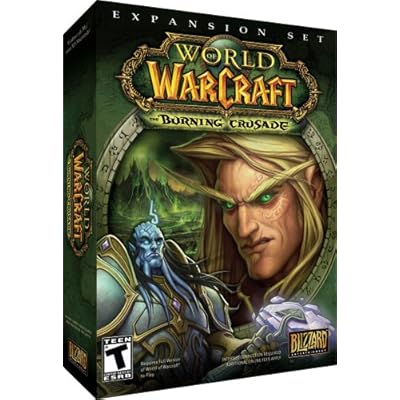
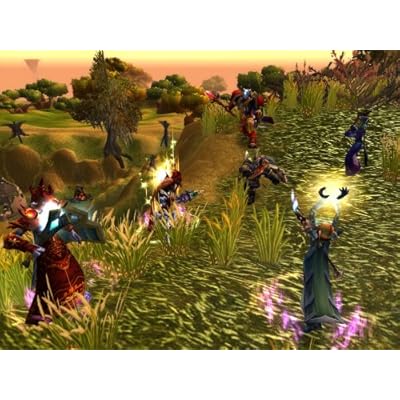
World of Warcraft: Burning Crusade

Flying mount, new quests, new monsters, new spells, jewelcrafting - these are just a few of the new features that The Burning Crusade has brought to the already popular game, World of Warcraft. The end game at level 60 was all that people had to look forward to when the original game came out.

For years, a collection of people would unite to destroy large dragons and other such monsters that just a single group could not accomplish. With the release of The Burning Crusade, the swarms of level sixty players find new challenges that await them in the Outlands. Outlands is the new continent where only seasoned players may put their skills to the test versus a new range of ravenous monsters. Along with new monsters comes the city of Shattrath, where the bulk of business is taken care of.

Within the city you are able to port to any other of the original cities at your whim, cutting down travel time. Another city available is The Exodar, which is home to the new Dranei race that appears to be blue fauns. Don't let the cute animal look deceive you, these creatures can take a beating and recover with their innate ability Gift of the Naaru, a heal over time spell with a three minute cool down. While the Dranei chose the side of the ally to aid in the epic battle, a new threat has arisen with their assistance going to the horde.


The Blood Elf, a cruel yet attractive race, has the power to cause destruction in its wake. The release of the Blood Elf Paladin has become a popular choice with the horde now having the ability to become a class that was never before allowed. Meanwhile the Dranei bring the shaman class to the ally to balance the scale of power.

Within the Outlands characters now have the ability to control their own flying mounts! Soaring the skies has become a reality in the land of Azeroth, along with being able to group with horde or alliance due to the new system of Scryer and Aldor. If you can believe it, a human and orc can work as a team!

In addition to the teamwork, players find that level seventy is a difficult goal to reach but in the end it has delicious rewards. Along with character levels, crafting skill levels have had the bar raised and even incorporated a new skill called jewelcrafting. Jewelcrafting is a skill that allows for earrings, rings, and necklaces to be crafted. At higher levels, gems can be cut to fit socketed armor allowing players to customized gear for maximum performance. With all these addition and so much more The Burning Crusade is a must have for all hardcore MMORPG lovers everywhere.


Diambil dari http://blogcritics.org/archives/2007/06/13/122551.php

Cheat untuk Games Windows XP

Ditengah - tengah kerjaan yang lumayan membosankan, terkadang teman2 menggunakan waktu untuk bermain game.
Karena dikantor ga boleh meng-install game, jadi kita cuma bisa main game yang sudah disediakan oleh Windows.
Sering kesel karena kalah mulu? he3x.
Cheat terkadang tidak hanya agar kita menang.
Tapi aku menggunakan cheat untuk menghibur diri.

Ini ada beberapa cheat untuk game - game Windows XP.

1. FreeCell
- Langsung menang :
Tekan Ctrl + Shift + F10 dan akan menampilkan window konfirmasi. Tekan abort untuk memenangkan permainan.
- Game rahasia :
Pilih Game - Select Game atau tekan F3, masukkan angka -1 atau -2. Kalian akan menemukan susunan kartu yang indah. Silahkan menamatkan permainannya...

2. MineSweeper
- Menghentikan waktu :
Tekan Window + D pada saat permainan berlangsung. Ini akan membuat semua window minimize. Buka kembali window minesweepernya dan kalian bisa bermain sesukanya tanpa batasan waktu.

3. Solitaire
- Langsung menang :
Tekan Shift + Alt + 2 dan kalian bakal ngeliat animasi menangnya....he3x.
- 3 deck jadi 1 deck saat bermain
Kalo kamu sedang menghadapi permainan dengan menggunakan 3 deck, tekan Ctrl + Alt + Shift lalu tekan deck. Akan tampil deck dengan satu kartu aja.

4. Pinball
- Bola tidak terbatas
Tekan BMAX dan bermainlah sepuasnya.
- Record dengan 1.000.000.000 points
Tekan "HIDDEN TEST". Trus tekan H dan kamu bakal ngisi record dengan nilai satu milyar.
- Bolanya ngikutin mouse kamu
Tekan M. Trus di papan pinballnya, tekan aja tombol mouse kiri kamu. Dan kamu bakal bisa ngatur bola sesuka kamu deh....

Lucu juga ya cheatnya.
Kalo ada yang nemuin cheat baru, kirimin ke aku donk.
Selamat menikmati.......

Thursday, 14 June 2007

Mafia


Sebuah game bergenre Adventure seperti GTA yang pernah aku mainkan.
Belum tamat sih....
Tapi kenangan memainkan game ini masih kerasa lho.
Keren banget....
Graphicsnya, story line-nya, dan yang paling kerasa itu suasana Italia jaman dulu banget....

Ceritanya dimulai dari seorang sopir taksi yang secara tidak sengaja bertemu dengan beberapa mafia.
Si sopir di minta untuk mengantarkan mafia yang terluka ke suatu tempat persembunyian.
Sambil menghindari kejaran dari mafia lain, si sopir melaju melewati jalan - jalan Italia di malam hari.
Indah banget euy..... Jadi pengen kesana.

Trus, si sopir jadi sering dapat panggilan dari si mafia yang ditolongnya.
Di minta tolong lagi untuk ngater2in si mafia ketempat pertemuan.
Eh lama kelamaan si sopir jadi masuk deh dalam anggota kelompok mafia tersebut.
Sampe ada adegan menyerang kelompok mafia lain di bar.

Ada satu misi yang cukup seru dimana si sopir taksi tersebut disuruh ikutan balapan F1.
Tau kan model mobil F1 jaman jebot?
Harus urutan pertama.
Sempet ngulang berkali-kali nih di misi ini.
Mobil kecil yang cepet banget kalo nyenggol sedikit aja dah melambung kemana - mana.
Tapi seru banget....

Seperti yang aku bilang diatas, game ini ada kemiripan dengan GTA (Grand Thief Auto).
Di game Mafia ini, kita juga bisa mengkoleksi berbagai macam mobil yang berhasil kita rampok dijalanan.
Mobil - mobil kuno bok.
Dah ga ada mungkin mobil kayak gitu di jaman sekarang.
Klasik banget.
Kita bisa balap2an ama polisi juga lho....
Kita juga menjalankan misi - misi di luar misi utamanya.
Dilengkapi dengan persenjataan yang juga kuno.
Shotgunnya yang besar gitu loh.
Trus ada bom minyak juga.

Yang paling aku suka dari game ini adalah suasana Italia klasiknya.
Dari pemandangannya, mobil2nya, senjata2nya, pantainya, semuanya klasik banget deh.
Trus kita juga tau kehidupan mafia Italia yang terkenal di dunia ini.
Dari persaingannya dalam bisnis, sampe peperangan antar mafia.

Secara keseluruhan, game ini bagus banget deh...
Kalo yang pernah main GTA, ga ada salahnya nyoba game ini.
Menurut aku malah lebih seru game Mafia ini.
Kalo mo liat rating game Mafia ini, klik ada link ini.
Hayo main game lagi, disela-sela kesibukan kantor dan kesibukan ngebuat game juga, he3x....